

Editorial illustration: reviewing an EB-3 employer and case documents.
Reviewed: 19 October 2026. A headline about PERM processing can make an EB-3 applicant wonder whether their own case has stopped. The useful first step is to identify exactly what the report covers: a particular employer, a government processing queue, or a broader policy. These are different questions. A screenshot without its original notice cannot answer all three.
This guide gives Bangladesh- and Korea-based applicants a practical way to organize those questions. It does not announce a new nationwide suspension or predict the outcome of an individual case. Before making a payment or changing plans because of a headline, connect the claim to a dated source, the correct employer and your documented application stage.
1. Start with the original notice, not the forwarded headline
Save the article URL, publication date and the government announcement it cites. Open the original page yourself. Check whether the date belongs to the event or merely to the website's latest update. An older announcement shared again today does not become a new restriction.
Read the scope carefully. Does the text identify a company, a category of applications, an investigation or a rule? Does it describe an allegation, an announced action, a proposal or a final decision? Write down the exact subject in plain language. If the report refers to one employer, do not silently turn that into a conclusion about every EB-3 sponsor.
When no primary source is available, label the claim unverified. Ask your representative which official notice affects your employer and why. “Everyone is saying it” and “your case is definitely safe” are both incomplete answers without supporting evidence.
2. Separate employer identity from agency branding
The recruitment agency, consulting company, law firm, workplace brand and petitioning employer may have different names. Start a simple record containing the employer's full legal name, worksite address, proposed position and the person responsible for case updates. Compare those details with the documents you have actually received.
A familiar brand name alone is not enough to match a news report to a filing. Ask for clarification when a document uses a subsidiary, a different spelling or another corporate entity. Do not assume that similar names prove a connection, or that a different trading name proves there is none.
The State Department describes EB-3 Other Workers as positions requiring less than two years of training or experience that are not temporary or seasonal. Its guidance also distinguishes labor certification from the employer's immigrant petition. Use those distinctions to ask precise questions about the proposed job and the documents associated with it. Read the official employment-based visa overview.
3. Identify the stage your evidence actually supports
A consultation agreement, a job offer, a filing acknowledgement and an approval notice do not communicate the same thing. Create one row for each document: document name, issuing organization, date, relevant reference and what it confirms. Keep an additional column for what remains unknown.
For example, if you only have an engagement agreement, describe your position as “agreement received; filing evidence requested.” Do not rename it “application approved.” If your representative says a filing has occurred, ask what document or written confirmation supports that statement and which organization received it.
Use the appropriate official verification route for the stage, with help from the responsible representative where necessary. Do not enter a PERM identifier into an unrelated tracking system and treat an error message as proof of rejection. Equally, a generic processing-time page cannot authenticate a particular applicant's documents.
4. Read processing information without turning it into a promise
The DOL FLAG page reviewed for this article labels its PERM table “as of 10/05/2026” and lists December 2025 for analyst review. That describes the filing period being worked on, not your personal completion date. The page also cautions that individual processing times vary. Check the current FLAG table.
Keep the table's own date next to any number you save. Do not confuse the prevailing-wage table with the PERM application table on the same page. When you return later, compare the same type of queue and record the new observation separately.
For planning, ask your representative to separate confirmed milestones from estimates. A useful update says what has happened, what is pending, what evidence supports the update and when another check is expected. It should not turn a general average into a guaranteed travel or visa date.
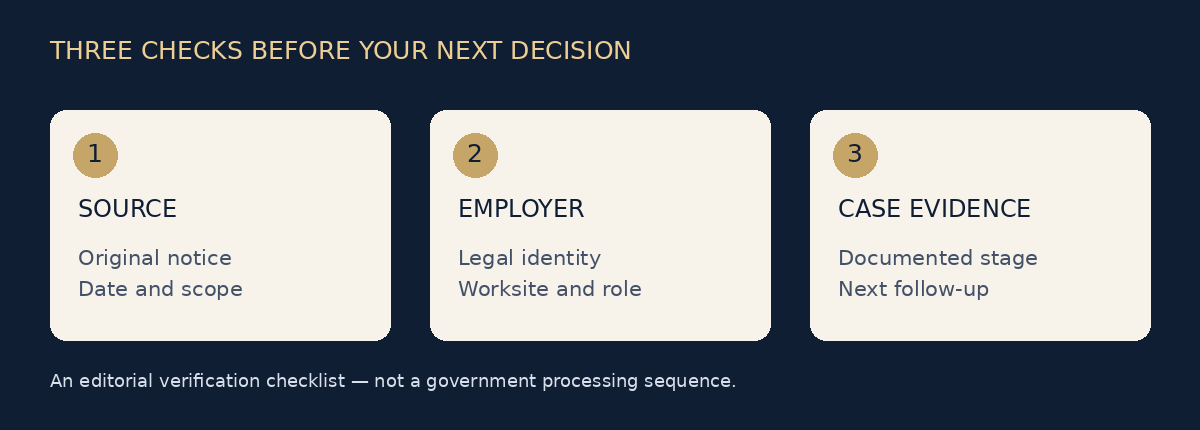
5. Use this checklist before your next decision
| Check | What to request | What to avoid assuming |
|---|---|---|
| News source | Original notice, event date and scope | A shared headline covers every sponsor |
| Employer | Legal name, worksite and position | An agency's brand identifies the petitioner |
| Case stage | Dated evidence and written explanation | An agreement means a filing or approval |
| Money | Itemized invoice and written terms | A new fee automatically removes a delay |
| Next action | Responsible person and follow-up date | Silence confirms either success or failure |
Before an additional payment, ask what service is being purchased, who receives the funds, which written terms apply and what happens if that service cannot be delivered. Whether a particular immigration-related charge is permissible can require legal advice; an invoice alone does not settle that question.
If explanations conflict, collect the documents and obtain advice from an appropriately qualified U.S. immigration lawyer before making a consequential change. Do not alter dates, create missing records or sign a statement that you do not understand to make the paperwork appear consistent.
6. Keep a short, useful evidence file
Make three folders: original documents, correspondence and official sources. Keep originals unchanged. Record when you received each item and who supplied it. When a phone conversation contains an important update, request a short written follow-up rather than relying on memory.
A clear message might say: “Please confirm the employer's legal name, my present case stage, the supporting document and whether the notice linked below affects this filing. Please distinguish confirmed information from estimates and identify the next follow-up date.” This asks for usable evidence without presuming that a problem exists.
Share sensitive records only through the agreed secure channel. For a general enquiry, a short summary is often enough to start. Avoid posting passport details, full reference numbers or unredacted notices in public comment groups. Organized records make a consultation more productive; they do not guarantee approval.
Frequently asked questions
Does a suspension headline mean all EB-3 cases have stopped?
The headline alone cannot establish that. Read the original action and its scope, then check whether it applies to your employer and stage.
Can I prove my case is unaffected using the FLAG table?
No. The table describes processing activity. It is not a personalized confirmation about your employer or application.
Should I immediately change sponsors?
Do not make that decision from a screenshot. Ask a qualified lawyer to review your documents, options and the consequences of any proposed change.
Is an agency reference number enough?
Ask which system issued it and what it identifies. An internal customer reference is not automatically a government filing reference.
What should I prepare for a consultation?
Bring a dated case summary, employer details, relevant notices, agreements, payment records and the source that raised your concern. List unanswered questions separately.
For background, explore GVS EB-3 information. To discuss your enquiry, use the GVS contact page. This is general educational information, not individual legal advice or a visa guarantee.