
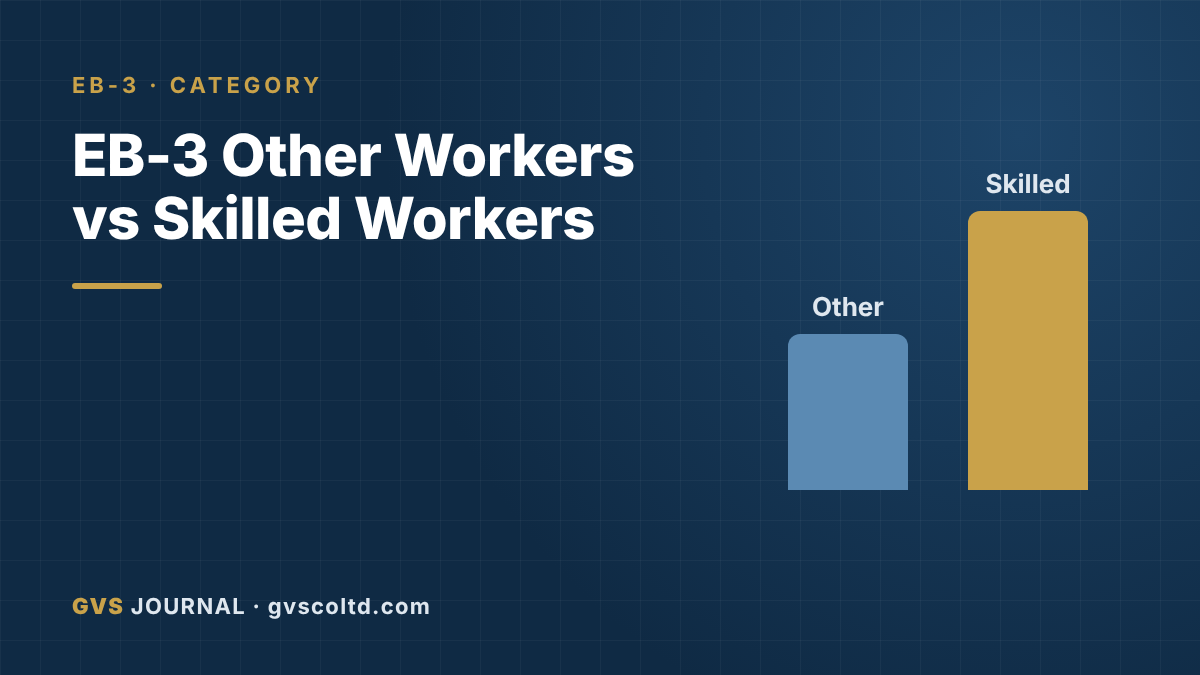
Short answer: EB-3 has two separate waiting lines in the Visa Bulletin. Jobs that need less than two years of training or experience go into Other Workers (often called "EB-3 Unskilled"). Jobs that need at least two years go into Skilled Workers, which shares a line with Professionals. In November 2026 the Skilled line was about two years ahead of the Other Workers line. The job's real requirements decide your line – not your wish.
Three groups, two lines
| Group | What the job requires | Visa Bulletin line |
|---|---|---|
| Professionals | A U.S. bachelor's degree or foreign equivalent, normally required for the job | "3rd" |
| Skilled Workers | At least 2 years of training or experience | "3rd" |
| Other Workers | Less than 2 years of training or experience | "Other Workers" |
These definitions come from USCIS's EB-3 page. Most factory, food processing, packing, cleaning, hotel housekeeping and farm jobs offered to workers from abroad need little or no experience, so they are Other Workers cases.
How far apart are the two lines?
In the November 2026 Visa Bulletin, for people born in Bangladesh, Korea and other "all chargeability" countries:
| Line | Final action date | Waiting time it shows |
|---|---|---|
| EB-3 Skilled Workers and Professionals | 15 June 2024 | about 2 years and 5 months |
| EB-3 Other Workers | 1 June 2022 | about 4 years and 5 months |
Why the difference? The law allows at most 10,000 Other Workers visas a year worldwide, while many more people apply in this group. A smaller number of visas for a big group means a longer line. You can compare both lines month by month since 1995 on our Visa Bulletin history page.
Who decides the category?
The category is fixed by the PERM labor certification. In PERM the employer writes down the minimum requirements of the job, and the Department of Labor checks that these requirements are normal for that kind of work. Three things follow from this:
- The employer cannot add "2 years of experience" just to get a faster line. Requirements that are not normal for the job can lead to an audit or denial.
- You must already meet the requirements on the day PERM is filed (your priority date), and prove it with experience letters from former employers.
- Experience gained with the same sponsoring employer often cannot be counted. Ask the attorney before relying on it.
Can I switch from Other Workers to Skilled?
Not by a simple request. A Skilled Workers case needs a different job offer with real two-year requirements, a new PERM and a new I-140. In many cases an approved I-140 lets you keep your earlier priority date for a later approved petition, but this depends on the facts and must be checked by an attorney. Starting again also means new costs and a new employer process – it is rarely the quick fix people expect.
Moving the other way also happens: if the employer withdraws, the worker may need a new sponsor. Our PERM report shows which kinds of jobs and employers file PERM cases and how long they take.
Worked example
- Rahim (example name) works in a Korean factory and has no documented experience in the U.S. job. His job offer is a poultry processing position with no experience requirement → Other Workers.
- Karim (example name) has worked 3 years as a welder and has employer letters for it. A U.S. employer offers a welder job that normally requires 2 years → Skilled Workers, if the attorney confirms the requirements and his letters.
- If both filed PERM in the same month, Karim's date would usually become current earlier – but Karim's case also depends on proving his experience, which can bring requests for evidence.
What this means for your planning
- Plan for about 5 years in total for an Other Workers case; check the bulletin every month.
- Keep experience letters, payslips and certificates from every job – they matter if you ever qualify for Skilled Workers.
- When your date is near, NVC uses the "dates for filing" chart to invite documents (see the State Department's NVC steps). Prepare early with our document checklist.
FAQ
Is "EB-3 Unskilled" an official name?
No. The official name is "Other Workers". "Unskilled" is the common name.
Does my country of birth change the line?
Yes. Each line has its own date for each country group. Bangladesh and Korea are both in "all chargeability"; India and the Philippines have their own dates.
Does the category change the green card itself?
No. Both lead to the same permanent residence. Only the waiting line and the requirements differ.
More about the process: EB-3 Unskilled – requirements and process.
This article is general information, not legal advice. Your attorney decides on your case. Dates are from the November 2026 Visa Bulletin and change every month.