
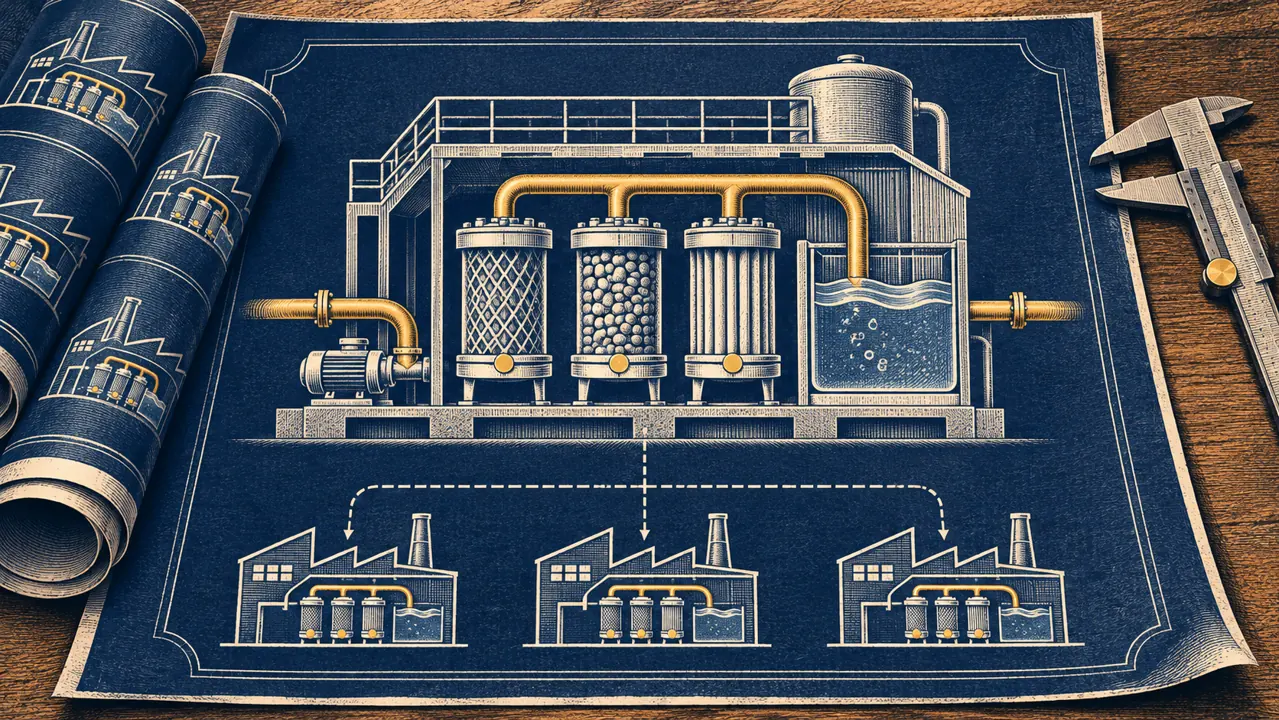
Editorial illustration: testing a water-reuse method for use beyond its first plant.
Suppose an engineer develops a way to reuse rinse water on one production line. The plant buys less water, and the manager can show the bills. That is a useful result. But if the engineer wants to pursue related work in the United States through an EB-2 National Interest Waiver (NIW), the bills leave an important question unanswered: what could change beyond that one plant, and why is that a credible possibility?
A local starting point does not disqualify a project. Nor does a large national problem make every local solution nationally important. The useful distinction is between what a trial has shown, what could travel to another setting and what would have to happen first. The factory below is a hypothetical example, not a client case or an approval prediction.
What USCIS means by the importance of the work
Under the USCIS precedent decision Matter of Dhanasar, the first part of the NIW inquiry concerns the proposed endeavor: does the specific work have substantial merit and national importance? Think of merit as the value of solving the problem, and national importance as a question about the work’s potential implications. An improvement in a manufacturing process can matter to a field even when development starts at one site. The decision does not turn that example into a rule that manufacturing projects qualify.
The distinction cuts both ways. A company can operate nationwide and still use an improvement only for its own internal convenience. A team in one industrial district, on the other hand, might address a technical bottleneck shared by many manufacturers. Drawing a larger map does little for either argument. Explain the bottleneck, who encounters it, and what feature of the proposed work might change how others deal with it.
Keep this inquiry separate from the rest of the petition. EB-2 classification requires its own basis, such as qualifying as an advanced-degree professional or a person of exceptional ability. The waiver also asks whether the person is well positioned to advance the work and whether, on balance, waiving the job offer and labor certification requirements would benefit the United States. A persuasive pilot study cannot answer every one of those questions.
Read a plant’s records for what they actually measure
Start with the bill. A lower monthly charge could reflect a change in price, fewer production shifts or a new meter. Even a clear drop in water volume says little about efficiency if production fell at the same time. Compare like with like: for example, the volume of fresh water used per batch of the same product before and during the trial. Record how a batch was defined, which meter was read and whether both periods included cleaning cycles.
Next, identify the tradeoff the plant would need to accept. Did reuse require more energy for filtration, or did the team stop the test when input quality changed? The point is not to manufacture a perfect result. A record that says when the method failed may tell the next operator more than a slide advertising the best day’s savings. If all you have is a monthly bill, describe a change in the bill; do not relabel it as a verified process efficiency gain.
Explain how another operator could use the result
Imagine the first plant can run the method because it has a particular filter, unusually clean incoming water and a technician trained to adjust the controls. Which of those features are essential? Which could another plant reproduce without replacing its entire line? A short operating specification, a test under different input conditions or a comparison of installation costs can give a reader a way to evaluate the answer.
Then describe the route from a promising method to possible use. Perhaps an equipment supplier is willing to test it on a second type of line. A dated test plan identifying the line, the technical question and the person responsible is different from an email asking for more information. Both are worth describing accurately. Neither means the supplier has bought the equipment, adopted the method or committed all its customers to using it.
Broad effects need not take the form of product sales. A measurement protocol others can use to compare treatment methods might be the most valuable output of the work. In that case, explain who needs comparable measurements and how they might obtain and use the protocol. A privately held technique can also have a route to use, such as licensing; naming that route does not establish that permission or an agreement already exists.
Give U.S. projections a boundary
For a test completed in Korea or Bangladesh, make two notes. The first describes what happened there. The second describes the U.S. setting where the proposed work could be useful. Do not move a measured result from the first note into the second without explaining the differences. Water prices, production schedules, maintenance capacity and feedwater quality can all affect whether an operator would try the method.
A common shortcut is multiplying one plant’s best result by the number of factories in the country. That calculation silently assumes that every factory is compatible, every operator adopts the change and every installation performs equally well. Instead, define the kind of line for which the estimate might apply. State the assumptions, distinguish technical potential from expected adoption, and say what a second trial would resolve. If the available data do not support a national figure, leave it out.
Prepare a one-page account someone else can check
Use these four entries as a working note, not a government form. Give each item a date and name its source. The exercise is particularly useful when a presentation prepared for customers makes a stronger claim than the engineering records support.
- Observed: Identify the trial, baseline and unit of measurement. Link each reported result to the underlying record.
- Relevant elsewhere: Identify the class of equipment or users that face the same problem, and the evidence for that connection.
- Still uncertain: Name the condition that could prevent transfer. Describe the next test without reporting it as completed.
- Your contribution: Separate what you designed or tested from what the employer, vendor and other team members did.
Before sharing records, check whether you have permission to disclose them. A redacted report should still make clear what was measured and who can explain the method. If a crucial detail cannot be shared, ask qualified counsel about an appropriate alternative rather than inventing a substitute figure. The general eligibility discussion on the GVS NIW service page is a starting point for a separate review of your circumstances.
Frequently asked questions
Do I need pilot sites in several states?
Geographic spread is not a standalone test. A second site can answer a real technical question, but adding locations simply to list more states does not explain broader implications. Identify what a different setting would actually help establish.
Does an industry report establish national importance?
It can document the size or nature of the problem. It usually cannot show, by itself, that your particular method addresses it. Connect the report’s population, equipment or operating conditions to the work you actually propose.
Should I count expected customers as adopters?
No. Separate an inquiry, a planned trial, a signed order and actual use. Report the status as of a stated date. A reader should be able to tell where a commercial conversation ends and evidence of implementation begins.
What if I cannot put a dollar value on the benefit?
Merit does not require an immediate financial return. For a technical project, a better way to compare methods or reliable knowledge about where a process fails can be meaningful. Explain who could use that knowledge and why the improvement matters.
Would proving wider impact mean I can start work in the United States?
No. This evidence concerns one part of an immigrant petition. It does not grant employment authorization, permanent residence or a visa. The petition and any later immigration steps have their own requirements.
Official sources
Checked 4 November 2026. This guide discusses published guidance and precedent; the working note is a preparation aid, not a filing requirement.
- USCIS precedent: Matter of Dhanasar, pp. 889–891
- USCIS: EB-2 NIW policy guidance
- DOL: Permanent labor certification
- State Department: Employment-based immigrant visas
If you are preparing an NIW consultation, bring one result you can document and one question about its wider use. Contact GVS to discuss how to organize those materials.