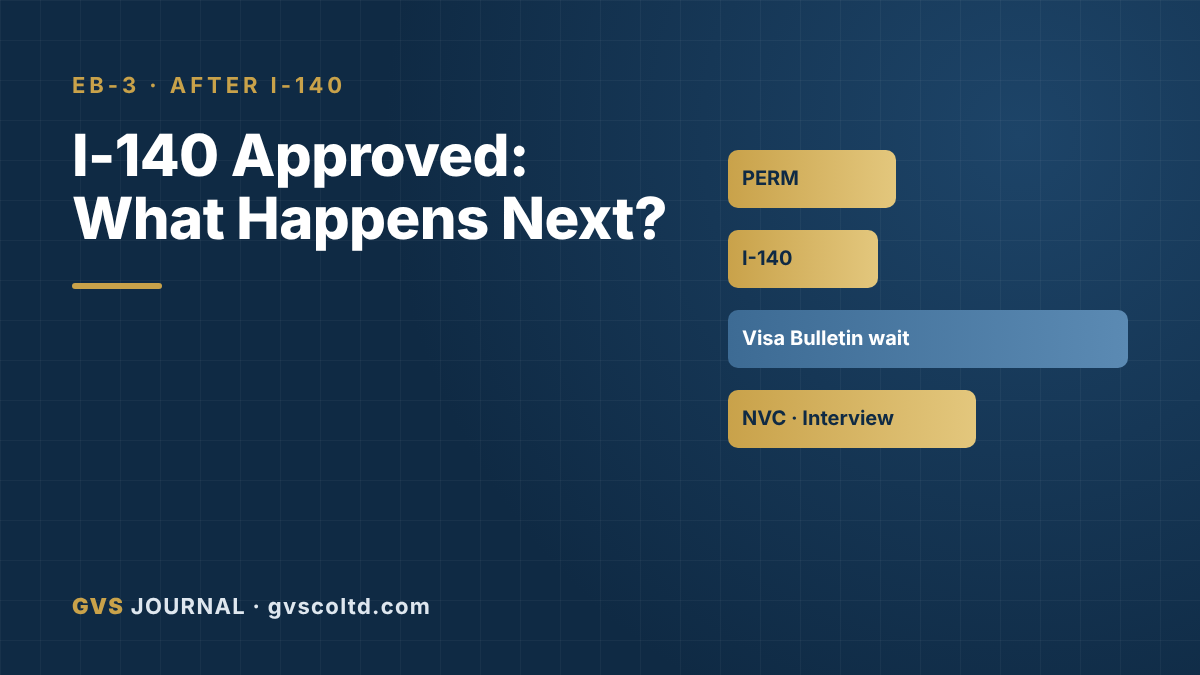
Your employer just told you: "Your I-140 is approved." So what happens next? Short answer: USCIS sends your approved I-140 to the National Visa Center (NVC). NVC opens a case and waits until your priority date comes close to the date in the Visa Bulletin. Only then does NVC ask for fees, the DS-260 form and your documents, and only when your date is current can the embassy give you an interview.
This guide explains each step after I-140 approval for EB-3 Unskilled (Other Workers) applicants in Korea and Bangladesh, with the newest official figures and a worked example.
What your I-140 approval notice means
USCIS sends an approval notice on Form I-797. It is an important step, but it is not a visa, a green card or a work permit. It means USCIS accepts that the job offer and you, the worker, qualify for EB-3.
Check three things on the notice:
- Your name and date of birth. They must match your passport exactly. Ask your attorney to correct any error early.
- Your priority date. For EB-3 this is the day your employer filed the PERM labor certification. Your place in the line depends on this date.
- The category. EB-3 Unskilled shows as "Other Workers" (Skilled Worker or Professional is a different line).
Keep a copy of the notice in a safe place. You will need the receipt number and the priority date many times.
I-140 approved: what happens next, step by step
- USCIS sends the petition to NVC. The State Department says to wait up to six weeks after the approval notice before contacting NVC (NVC general FAQs).
- NVC creates your case. It gives you an NVC case number and sends a letter. As of 16 November 2026, NVC said it was creating cases from petitions it received from USCIS on 30 October 2026.
- NVC holds the file until a visa is near. If no visa is expected in the next several months, NVC keeps the petition and waits. This is normal, not a problem.
- NVC asks you to start. When your priority date comes close, NVC asks you to choose an agent, pay the fees, fill in the DS-260 and upload your civil documents. Do not send documents or fees before NVC asks; the State Department says this delays a case.
- "Documentarily qualified". NVC checks your documents. As of 16 November 2026, it was reviewing documents submitted on 6 September 2026.
- Interview. When your priority date is earlier than the Final Action Date and your file is complete, NVC can schedule the interview in Seoul or Dhaka. Then come the medical exam and the visa decision.
Where the line is: November 2026 Visa Bulletin
The newest official bulletin when this article was written is the November 2026 Visa Bulletin. For EB-3 Other Workers, All Chargeability (this includes Bangladesh and South Korea):
| Chart | Date | What it decides |
|---|---|---|
| Final Action Date | 1 June 2022 | When a visa can be issued |
| Dates for Filing | 1 July 2022 | When NVC may let you prepare documents |
Read more in our guide Final Action Date vs Dates for Filing.
A worked example with dates
Two example workers (not real people), both with an approved I-140 in November 2026:
| Worker | Priority date | Compared with November 2026 | What happens |
|---|---|---|---|
| Worker A | 10 March 2022 | Earlier than the Final Action Date (1 June 2022) | NVC can ask for fees and documents now. An interview is possible once the file is complete. |
| Worker B | 5 September 2023 | Later than both dates | NVC creates the case and holds it. Worker B waits for the bulletin to move. |
Nobody can promise when the bulletin will reach Worker B. It can move forward, stand still or even go back. Our Visa Bulletin history shows how the EB-3 dates have moved every month since 1995.
How long is the wait after I-140 approval?
It depends on one thing: the distance between your priority date and the Final Action Date. If your date is already earlier, the next steps can take months. If it is later, you wait for the bulletin, and that can take years. Counting from the start of PERM, the whole EB-3 Unskilled process usually takes about 5 years. You can see each stage with today's official times on our green card timeline.
What to do while you wait
- Keep your contact details up to date with NVC and your attorney: address, phone and e-mail.
- Keep your passport valid. Renew it early if it will expire soon.
- Prepare documents, but do not upload them yet. Birth and marriage certificates, police certificates and translations take time. Use our document checklist.
- Check your children's ages. A child must be under 21 to come with you, but the Child Status Protection Act (CSPA) can protect some children. Try our child age (CSPA) calculator.
- Stay in touch with your employer and keep your visa status in Korea valid. The I-140 gives you no status in Korea.
FAQ
Can I go to the U.S. or work there after I-140 approval? No. The approval is not a visa. You can enter as a permanent resident only after the embassy issues your immigrant visa.
What if my employer withdraws the I-140 after approval? Under 8 CFR 205.1, a withdrawal less than 180 days after approval revokes the approval automatically. A withdrawal after 180 days or more does not, so the priority date can generally be kept. But without a job offer you need a new employer, a new PERM and a new I-140.
Should I pay NVC fees as soon as the I-140 is approved? No. Pay only when NVC sends you its fee instructions. Early payments or uploads can delay your case.
What GVS checks for you
For GVS clients, we check the approval notice for name and date errors, watch the Visa Bulletin each month, tell you when your priority date comes close, and help you prepare documents in Bangla, Korean and English. You can follow your case stage in the GVS client portal. We never promise an interview date.
Sources: Department of State NVC general FAQs; November 2026 Visa Bulletin; NVC timeframes as of 16 November 2026; 8 CFR 205.1 (eCFR). These rules and dates can change.
This article is general information, not legal advice. Your attorney decides on your case.