
Short answer: PERM labor certification is the first official step of an EB-3 Unskilled green card. The U.S. employer, not the worker, files it with the Department of Labor (DOL) to show that no qualified U.S. worker is available for the job. It has three parts: a prevailing wage decision, recruitment, and the Form ETA-9089 filing. With today's DOL speeds, the whole PERM stage often takes well over a year.
What is PERM labor certification?
PERM is the Department of Labor's "permanent labor certification" program. According to the DOL PERM page, a certified application allows an employer to hire a foreign worker to work permanently in the United States. DOL checks two things: that there are not enough able, willing and qualified U.S. workers for the job, and that hiring a foreign worker will not lower the wages and working conditions of U.S. workers.
For EB-3 Unskilled (Other Workers), the employer must have a certified PERM before it can file the I-140 petition with USCIS. The rules are in 20 CFR Part 656.
PERM labor certification steps for EB-3
- The employer defines the job. Duties, place of work and the real minimum requirements. For Other Workers, the job needs less than two years of training or experience.
- Prevailing wage determination (PWD). The employer asks DOL's National Prevailing Wage Center what the normal wage is for this job in that area. The offered wage must be at least this amount. See our prevailing wage page.
- Recruitment. For a non-professional job, the employer must at least place a job order with the State Workforce Agency for 30 days and run newspaper ads on two different Sundays. A "notice of filing" must also be posted at the workplace for at least 10 consecutive business days.
- Waiting period. These recruitment steps must be done at least 30 days but no more than 180 days before the PERM is filed. U.S. applicants who answer must be considered honestly.
- Filing Form ETA-9089. The employer (usually through its attorney) files online in the DOL FLAG system. This filing date becomes your priority date (8 CFR 204.5(d)).
- DOL decision. An analyst reviews the case. DOL can certify it, deny it, or send an audit letter asking for recruitment documents.
How long does PERM take in 2026?
DOL publishes its speeds on the FLAG processing times page. These are the newest figures at the time of writing:
| Stage | Official figure | Date of the figure |
|---|---|---|
| Prevailing wage (PERM requests) | DOL was working on requests received in June 2026 | 30 September 2026 |
| Recruitment and waiting period | At least 30 days of job order, plus at least 30 days before filing (rule, not a DOL speed) | 20 CFR 656.17 |
| PERM analyst review | 300 days on average (last 30 days); 360 days (last 180 days) | 31 October 2026 |
| Audit | Not published by DOL; the employer gets 30 days to answer an audit letter | 20 CFR 656.20 |
So a clean case with no audit spends roughly three to four months on the wage step, about two months on recruitment, and around ten months in analyst review. An audit adds more time. Our PERM status page follows these numbers, and the PERM report shows which jobs and states DOL has certified.
A worked example with dates
This is an illustration with today's average speeds, not a promise for any case.
- 1 December 2026: the employer asks for a prevailing wage. If DOL keeps a similar pace, the answer could come around March–April 2027.
- April–May 2027: 30-day job order, two Sunday ads and the workplace notice, then the 30-day waiting period.
- Early June 2027: Form ETA-9089 is filed. This is the worker's priority date.
- Around spring 2028: at an average of about 300 days, DOL decides. Then the employer has 180 days to file the I-140.
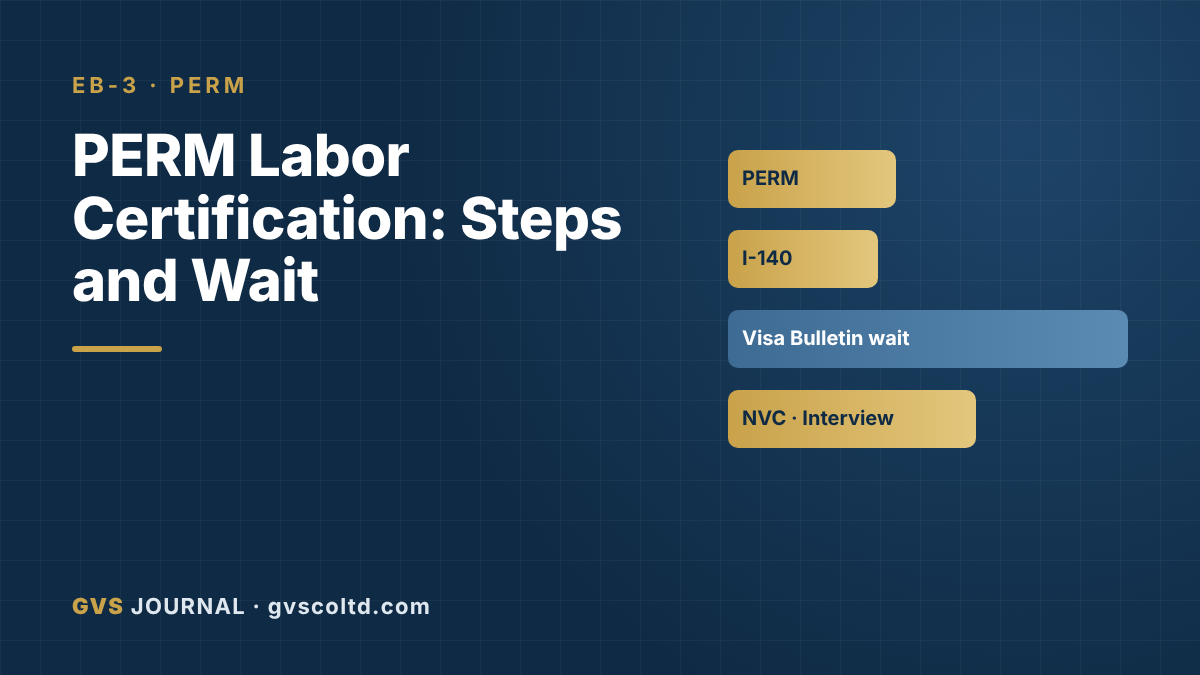
After PERM come the I-140, the wait for the Visa Bulletin and the NVC and interview steps. In the November 2026 Visa Bulletin, the EB-3 Other Workers Final Action Date for Bangladesh and all other countries not listed separately is 1 June 2022. The full EB-3 Unskilled process takes about 5 years; see our green card timeline.
What happens after PERM is certified or denied?
- Certified: the certification is valid for 180 calendar days. If the employer does not file the I-140 in that time, the PERM expires (20 CFR 656.30(b)).
- Audit: the employer must send the requested documents by the date in the letter, normally 30 days, with one extension of up to 30 days possible.
- Denied: the employer may ask DOL to reconsider within 30 days of the denial. Otherwise a new PERM, with a new priority date, is usually needed.
A note on rules: in March 2026 DOL proposed higher prevailing wage levels for H-1B and PERM. It is a proposal, not a final rule; the wage rules in force have not changed. Follow our rule changes page.
FAQ
Do I, the worker, apply for PERM myself?
No. PERM is the employer's application. You give your attorney correct personal details and proof that you meet the job's requirements, if any. You can stay in Korea or Bangladesh during PERM.
Can I be asked to pay for the employer's PERM?
No. Under 20 CFR 656.12(b), the employer must not ask for or accept payment from the worker for obtaining the labor certification, including its attorney's fees and recruitment costs. Read our article on who pays for PERM.
Does a certified PERM mean I will get a green card?
No. It only allows the employer to file the I-140. USCIS, the Visa Bulletin wait and the consular interview all still decide your case.
This article is general information, not legal advice. Your attorney decides on your case. PERM and prevailing wage times are from the DOL FLAG page (PERM as of 31 October 2026, prevailing wage as of 30 September 2026); Visa Bulletin dates are from the November 2026 Visa Bulletin. These figures change regularly.