
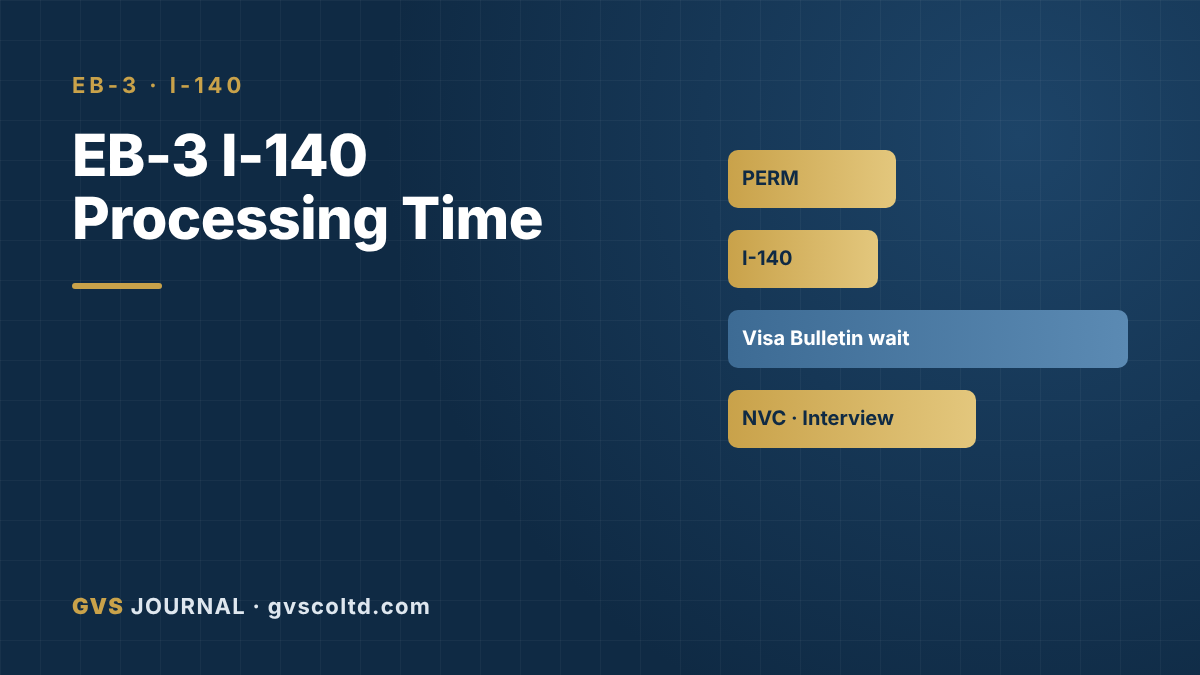
Short answer: the EB-3 I-140 processing time at USCIS is now close to a year without premium processing. On our I-140 data page, the USCIS median for the newest published quarter (fiscal year 2025, Q3) is 11.2 months, up from 6.8 months a year earlier. With premium processing, USCIS must take action within 15 business days. A slow I-140 does not move your place in line: your priority date was already fixed when the PERM was filed.
What is the I-140 in an EB-3 Unskilled case?
Form I-140, Immigrant Petition for Alien Workers, is the second official step after PERM. Your U.S. employer files it with U.S. Citizenship and Immigration Services (USCIS). It asks USCIS to classify you as an EB-3 "Other Worker". You do not file it yourself, but you give the documents that show you meet the job's requirements.
The employer must file it while the PERM certification is still valid. According to the USCIS I-140 page, a labor certification expires 180 days after DOL certifies it, and USCIS rejects an I-140 that contains an expired certification. Read our PERM labor certification guide for the step before.
How long does I-140 processing take in 2026?
USCIS publishes how many I-140 petitions it receives, approves and denies every quarter, and the median processing time. Our I-140 data page reads this report (updated 10 November 2026). These numbers cover all I-140 categories and all countries; USCIS does not publish Bangladesh or EB-3 Other Workers separately.
| U.S. fiscal-year quarter | Median I-140 processing time |
|---|---|
| FY2023 Q2 (Jan–Mar 2023) | 3.4 months |
| FY2024 Q1 (Oct–Dec 2023) | 6.3 months |
| FY2024 Q3 (Apr–Jun 2024) | 6.8 months |
| FY2025 Q1 (Oct–Dec 2024) | 7.6 months |
| FY2025 Q2 (Jan–Mar 2025) | 7.5 months |
| FY2025 Q3 (Apr–Jun 2025) | 11.2 months |
The queue has grown too: at the end of FY2025 Q3, 170,699 I-140 petitions were waiting, 81 % more than a year earlier. "Median" means half of the cases were faster and half were slower. Your own case can be quicker or slower, especially if USCIS sends a Request for Evidence (RFE).
Premium processing: what 15 business days really means
The employer can ask for premium processing with Form I-907. According to the USCIS premium processing page:
- For the I-140 in most classifications, including EB-3, USCIS must take "adjudicative action" within 15 business days. (NIW and multinational manager petitions have 45 business days.)
- "Action" means an approval, a denial, an RFE or a notice of intent to deny. It is not a promise of approval.
- If USCIS asks for more evidence, the clock stops. A new 15-day period starts when USCIS receives the answer.
- It can be requested together with the I-140 or later, while the I-140 is pending.
Whether to use it is the employer's and attorney's decision. Remember that the EB-3 Unskilled process takes about 5 years in total, and most of that time is the Visa Bulletin wait, not the I-140.
Does a slow I-140 delay my green card?
Usually not by itself. Your priority date is the day DOL received the PERM (8 CFR 204.5(d)). While the I-140 is pending, that date is already waiting in line. In the November 2026 Visa Bulletin, the EB-3 Other Workers Final Action Date for Bangladesh and other countries not listed separately is 1 June 2022 (Dates for Filing: 1 July 2022). See our Visa Bulletin history.
The I-140 speed matters in three cases:
- Your priority date is already current. Then the I-140 is the last thing before NVC, and every month counts.
- A problem must be found early. If USCIS denies the petition, the employer may need a new PERM, and a denied petition does not give a priority date (8 CFR 204.5(e)(3)).
- Children near age 21. Under CSPA, the time the I-140 was pending is subtracted from the child's age. A faster I-140 therefore does not help the child's CSPA age. Check our child age (CSPA) calculator.
A worked example with dates
This is an illustration, not a promise for any case.
- PERM filed: 1 June 2026 – this is the priority date.
- PERM certified: around April 2027 (DOL analyst review averaged about 300 days in the DOL processing times as of 31 October 2026).
- I-140 filed: May 2027, well inside the 180-day validity.
- Without premium processing: at the FY2025 Q3 median of 11.2 months, a decision around April 2028.
- With premium processing: USCIS action within 15 business days of receiving the request, if there is no RFE.
- Either way: the worker waits until the Visa Bulletin reaches 1 June 2026, which is years away at today's dates.
Our green card timeline puts these steps together with today's official speeds.
What USCIS checks, and what comes after approval
- The PERM is certified, still valid and for the same job.
- You met the job's requirements on the priority date (for Other Workers, the job needs less than two years of training or experience).
- The employer can pay the offered wage from the priority date onward (8 CFR 204.5(g)(2)), shown with tax returns, annual reports or audited financial statements.
After approval, USCIS sends the petition to the National Visa Center if you live outside the United States. When your date is current, NVC reviews your documents; on 9 November 2026, NVC was reviewing documents submitted on 31 August 2026. Once an EB-3 I-140 is approved, you can generally keep its priority date for a later employment-based petition, unless the approval is revoked for reasons such as fraud or a material error.
FAQ
Where can I see my I-140 status?
Your employer's attorney receives the receipt notice with a receipt number. With that number the case can be checked on the USCIS case status page. Ask your attorney for the receipt date and number.
Can I work in the United States while the I-140 is pending?
No. An I-140 is an immigrant petition, not a work permit. Workers in Korea or Bangladesh keep living and working where they are until the immigrant visa is issued.
My I-140 got an RFE. Is my case in danger?
Not necessarily. An RFE means USCIS needs more evidence, often about the employer's ability to pay or your experience. The answer must reach USCIS by the deadline in the notice.
This article is general information, not legal advice. Your attorney decides on your case. I-140 times are from the USCIS quarterly "All Forms" report as shown on our I-140 page (updated 10 November 2026); PERM times are from the DOL FLAG page as of 31 October 2026; Visa Bulletin dates are from the November 2026 Visa Bulletin. These figures change regularly.