
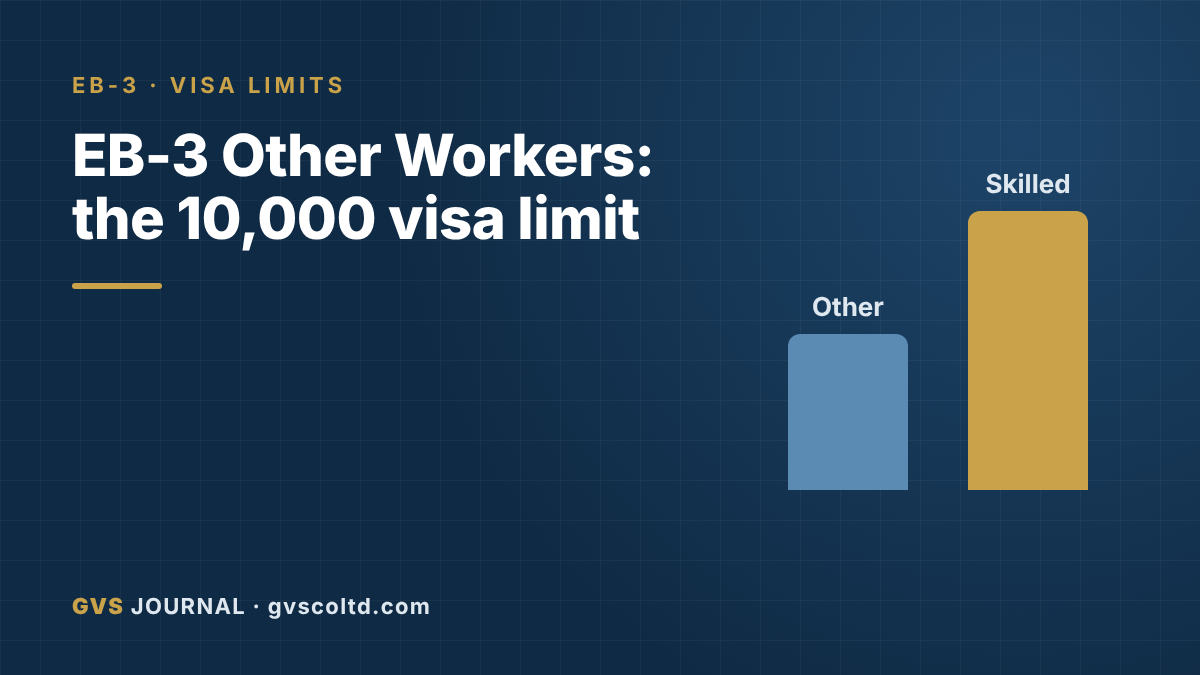
Short answer: U.S. law gives EB-3 "Other Workers" (the unskilled EB-3 line) not more than 10,000 visas a year worldwide, and an older law called NACARA can cut that number by up to 5,000 more each year. Because so few visas go to so many applicants, the Other Workers line moves more slowly than skilled EB-3. In the November 2026 Visa Bulletin the Other Workers Final Action Date is 1 June 2022, while skilled EB-3 is at 15 June 2024.
Many workers ask us: "Why is the EB-3 Other Workers visa limit so small, and what does it mean for my wait?" This article explains the numbers from the official sources, step by step.
What is the EB-3 Other Workers visa limit?
The Immigration and Nationality Act divides employment-based green cards into five preferences. The third preference (EB-3) gets 28.6% of the yearly employment-based number, plus any numbers EB-1 and EB-2 do not use. Inside EB-3 there are three groups: skilled workers, professionals and "Other Workers". The State Department's Visa Bulletin repeats the rule from the law: EB-3 numbers go to these groups, "not more than 10,000 of which to Other Workers".
So the 10,000 is a ceiling for the whole world, not for one country. Workers from Bangladesh, Nepal, the Philippines, Mexico, India and every other country share it. Your spouse and children also use visas from the same pool when they immigrate with you.
Why the real number can be lower: the NACARA reduction
In 1997 Congress passed NACARA (a law that gave green cards to some people from Central America and Eastern Europe). To balance those green cards, the law takes numbers away from the Other Workers category. The Visa Bulletin explains that "the 10,000 EW numbers available for a fiscal year are to be reduced by up to 5,000 annually". "EW" is the official code for EB-3 Other Workers.
The size of the cut changes from year to year. The State Department announces it in the bulletin, and in some years it has been only a few hundred. We do not guess this year's figure: check the newest bulletin before you plan.
The 7% per-country rule
There is a second limit. No single country may use more than 7% of all family and employment preference visas in one year. Large countries such as India, China, Mexico and the Philippines can hit this limit, so the bulletin sometimes gives them their own column with a different date.
Bangladesh has no separate column. Bangladeshi applicants use the "All Chargeability Areas Except Those Listed" column. That means you are in the same line as most of the world, and the date for that column is your date.
Skilled EB-3 vs Other Workers in the November 2026 Visa Bulletin
| All Chargeability (Bangladesh) | EB-3 Skilled / Professional | EB-3 Other Workers |
|---|---|---|
| Yearly ceiling | Rest of the EB-3 share | Not more than 10,000, minus NACARA |
| Final Action Date | 15 June 2024 | 1 June 2022 |
| Dates for Filing | see bulletin | 1 July 2022 |
| How far behind today (GVS Visa Bulletin history) | about 2.4 years | about 4.4 years |
For November 2026, USCIS says applicants who adjust status inside the United States must use the Dates for Filing chart. Workers in Korea or Bangladesh go through NVC and an embassy interview, where the Final Action Date decides when the visa can be issued.
You can see how both dates moved since 1995 on our Visa Bulletin history page. Cutoff dates can also move backwards (retrogression) when demand is higher than the yearly number.
A worked example with dates
- Your employer files PERM on 1 March 2023. This becomes your priority date once the I-140 is approved.
- In the November 2026 Visa Bulletin, the Other Workers Final Action Date is 1 June 2022.
- Your date (1 March 2023) is later than 1 June 2022, so your visa cannot be issued yet. The line must still move about nine months to reach you.
- How long nine months on the chart takes in real time is not fixed. Some years the date jumps; some years it stands still or retrogresses. Nobody can promise a month.
Read how to find your priority date if you are not sure which date is yours.
What the issuance numbers show for Bangladesh
The monthly State Department reports on our visa issuance page show that people born in Bangladesh received 91 EB-3 Other Workers visas in the last 12 published months (March 2025 – February 2026). In fiscal year 2025 Bangladesh was number 10 of 107 countries for this category.
These recent months are low for a special reason: immigrant visas for nationals of 75 countries, Bangladesh included, were paused from January to August 2026, and our page records a worldwide pause of immigrant visa interviews from late August 2026. See the policy updates page for the current status. PERM and I-140 processing did not stop.
What this means for your plan
- The whole EB-3 Other Workers journey takes about 5 years from start to green card. The yearly limit is the main reason for the long middle part.
- Filing PERM earlier gives you an earlier priority date. Your place in the line is fixed by that date, not by when the visa is finally issued.
- Children must stay under 21 for the CSPA calculation; check our child age (CSPA) tool early.
- Keep your passport, documents and job history ready, so you are not slowed down when your date becomes current.
FAQ
Does the 10,000 limit mean only 10,000 people a year?
It means not more than 10,000 visa numbers, and family members who come with you use numbers too. So fewer than 10,000 workers can be counted each year.
Can unused visas from other categories help Other Workers?
The law gives EB-3 the numbers that EB-1 and EB-2 do not use, but the 10,000 ceiling for Other Workers stays. That is why the Other Workers date can stay behind skilled EB-3.
Can I switch to skilled EB-3 to wait less?
Only if the job really needs at least two years of training or experience and you have it. The job offer, not your wish, decides the category. Your attorney checks this when PERM is prepared.
Official sources: U.S. Department of State – Visa Bulletin, USCIS – Adjustment of Status Filing Charts.
This article is general information, not legal advice. Your attorney decides on your case.